- AI System Monitoring
- AI Model Performance Management
- Model Retraining & Updating
- AI Maintenance
- AI Optimization
Developing and implementing an AI system is just the start. Model changes, integrations to be taken care of, infrastructure to be monitored, and business requirements change.

The need for ongoing management of AI is explained
With ZechionAI, you can expect continuous monitoring, maintenance, troubleshooting, retraining, optimization, security management, and operational assistance to ensure your AI environment continues to work as intended after deployment.
You don't have to, or want to, build a full-fledged AI operations team to maintain one or more AI systems. We can control the operational side with you—or for you.
An AI solution can be effective and continue to need a lot of care and attention in the months after it goes into production.
Model behavior can be changed with new data. Expectations of customers can change. APIs can change. Integrations can fail. Expenses for infrastructure can rise. A successful model can start to become ineffective over time.
Hence, ZechionAI considers deployment as a milestone rather than the finish line.
Dedicated Support & Managed Services offer an ongoing operational capability of your AI solutions. Our team can keep an eye on the health of the system, troubleshoot issues, handle integrations, manage model updates, oversee retraining, optimize performance and costs, and deliver periodic reporting, based on your needs.
The goal is simple: to ensure the AI remains useful, reliable, secure, maintainable and relevant to the business it serves.
Unlike traditional software, AI systems can be affected by modifications in the data, user behavior, model versions, prompts, integrations, infrastructure, and business conditions.
An ongoing management might be needed to deal with:
- Simulate drift given the changes in real-world conditions.
- Data drift - when production data is different from the data developed.
- Integration issues with API, database, applications or third-party platforms.
- Any decline in performance resulting from accuracy, latency, reliability or workflow completion.
- Any infrastructure modification that impacts capacity, or availability or cost.
- Security requirements that adapt to the changing systems and threats.
- Updates to models that need to be tested in the controlled environment prior to production.
- Model updates that need to be tested in the controlled environment before production.
- Rising AI usage which can result in unexpected expenses.
- Modifying business processes that need workflows or models to be modified.
- Feedback from users that identifies issues that were not apparent on initial deployment.
These issues can easily fall within an overworked internal IT or product or development team if there is not clear ownership.
ZechionAI is offering that operational ownership as a service.
What should happen after the deployment?
AI operations have a continuous life cycle:
- 01
Deploy
Test and implement the approved solution for AI.
- 02
Monitor
Monitor and report on the technical, model, operational, security, usage and business indicators.
- 03
Detect
Detect errors, anomalies, drift, unusual usage, performance degradation and potential risks.
- 04
Troubleshoot
Investigate incidents, determine the root causes and coordinate appropriate corrective action.
- 05
Maintain
Maintain Applications, Integrations, Configurations, Dependencies, Models and Supporting Environments.
- 06
Retrain
Update or retrain models as data, performance and business needs dictate.
- 07
Optimize
Enhance performance, accuracy, latency, workflows, resource usage and costs.
- 08
Secure
Track access, changes, security events and other agreed controls.
- 09
Report
Distribute valuable data on system health, incidents, usage, costs and performance.
- 10
Improve
Transform insights from operations to actionable recommendations for the subsequent phase in the AI lifecycle.
Deployment is the way to get your AI into production. Managed operations are essential to retain it – and retain it useful.
Dedicated Support & Managed Services Overview
ZechionAI offers support at both technical and operational levels that support your AI environment.
AI System Monitoring
We track the elements that enable your AI application to operate, such as:
- Model performance
- Application health
- Infrastructure health
- API availability
- Integration status
- System availability
- Response latency
- Error rates
- AI usage
- Workflow execution
- Resource utilization
Scope of monitoring depends on your architecture, technology stack, business requirements and service agreement.
AI Model Performance Management
A model can be technically viable but poor business performers.
Our model operations services can include:
- Accuracy monitoring
- Incorporate precision and recall monitoring (where applicable).
- Model drift detection
- Data drift detection
- Performance benchmarking
- Threshold monitoring
- Prediction-quality reviews
- Model degradation analysis
- Performance trend reporting
- Suggestions for corrective action.
The goal is to detect changes in the model behavior, before they become bigger operational issues.
Model Retraining & Updating
Retraining must be done under control when the model requires changes.
Services can include:
- Scheduled retraining
- Trigger-based retraining
- Dataset updates
- Feature updates
- Model version management
- Training pipeline support
- Validation prior to production release.
- Performance comparison
- Controlled deployment
- Model rollback support
Agreed performance indicators, data changes, business requirements and the results of validation are used to make retraining decisions.
What was the reason for this?
If there is some kind of a breakdown, the focus is on what happened and get that service back up and running as quickly as possible.
ZechionAI can investigate:
- Production AI failures
- Model failures
- API failures
- Integration problems
- Unexpected outputs
- Performance degradation
- Workflow failures
- Configuration issues
- Infrastructure problems
- Data-related issues
Investigation, root cause analysis, remediation, escalation, documentation, and follow-up recommendations are all elements of our incident process.
AI Maintenance
The continuous maintenance can include:
- Software updates
- Dependency updates
- Infrastructure maintenance
- Configuration management
- Integration maintenance
- Model maintenance
- If applicable, send out prompt or workflow updates.
- Environment management
- Documentation updates
- Production change coordination
Maintenance activities run as part of agreed change-management process.
AI Optimization
As the use of AI continues to increase, the original setup might not be the most efficient.
Optimization services are able to solve:
- Model performance
- Inference efficiency
- AI operating costs
- Workflow design
- Resource utilization
- Response latency
- Accuracy
- Automation efficiency
- Infrastructure configuration
- API consumption
We seek opportunities to move forward in the system in a useful way and without adding complexity.
MLOps & Production Management
ZechionAI can help organizations leverage the production lifecycle for machine-learning workloads through the following:
- Model deployment management
- CI/CD support
- Model versioning
- Experiment tracking
- Production release management
- Environment management
- Monitoring pipelines
- Automated testing
- Deployment validation
- Rollback procedures
It's all about repeatability, control, and manageability of AI operations.
AI Security Monitoring
Security is an ongoing element of AI operations, not just a thing to be taken care of in implementation.
Services may consist of:
- Access monitoring
- Authentication monitoring
- Data protection controls
- Suspicious activity monitoring
- Model security reviews
- Safety will be monitored for prompt-injection as needed.
- Security event review
- Incident escalation
- Change monitoring
Security controls are tailored to the client's architecture, risk profile, technology infrastructure and applicable requirements.
Services involving AI Governance & Compliance Support
Businesses may require insight into the modifications and usage of AI models.
ZechionAI can support:
- AI usage monitoring
- Model documentation
- Assistance in preparing and supporting the audit.
- Preparation and support for audit.
- Change tracking
- Access controls
- Risk monitoring
- Governance reporting
- Policy alignment
- Model lifecycle documentation
In regulated environments, there are certain security, privacy, governance and compliance requirements that can be integrated into the service design. Any obligations and responsibilities that are relevant are still subject to environment and regulatory requirements of the client.
AI Cost Monitoring
The cost of using AI may vary depending on the volume of data or the number of requests placed. The expenses for using AI can fluctuate with usage.
We can monitor:
- Infrastructure costs
- API usage
- Model consumption
- Resource utilization
- Where appropriate, the use of tokens to consume multiple items.
- Cost anomalies
- Usage trends
- Resource efficiency
Reports and recommendations can be used to determine wasteful use and cost savings opportunities.
User & Application Support
Our team can also support the use and applications that are hooked up to AI systems.
This may include:
- User issue investigation
- Application support
- Workflow troubleshooting
- Configuration assistance
- Technical investigation
- Support documentation
- Escalation management
- Recurring issue analysis
Performance & Business Reporting
Operational reporting can give a view into:
- Monthly system performance
- Model health
- Incidents
- Usage
- AI costs
- System trends
- Optimization opportunities
- Business KPIs
- Recommended actions
The reporting structure may be changed to executives, IT team, AI team, operations team or other stakeholders.
What We Monitor
ZechionAI can be installed to monitor:
- Model accuracy
- Model drift
- Data drift
- API availability
- Response latency
- Error rates
- Application health
- Infrastructure utilization
- AI usage
- The use of tokens/API as needed.
- Workflow execution
- Integration health
- Security events
- Cost anomalies
- User feedback
- Business KPIs
Not all of the metrics are suitable for all environments. The monitoring architecture is customized to the target architecture and the business concerns.
Reactive Support
A problem occurs.
Client observes it, reports it, waits for investigation, works with technical teams and awaits resolution.
This can be effective for lower criticality systems, but requires greater consciousness of internal teams to detect and escalate issues.
Proactive Managed Support
The environment is monitored continuously or as per the agreed plan.
ZechionAI can:
- Monitor
- Recognize warning signs
- Investigate
- Resolve/Escalate
- Document
- Recommend improvements
It is not just who is answering a Support Ticket.
It's whether someone is proactively responsible for knowing whether or not the AI environment is healthy before small things become big operational issues.
Problems We Solve
- 01
“Our model is not as accurate as it used to be for AI.”
Agreed performance indicators can be tracked and potential drift or changes in data explored and appropriate action recommended such as re-calibration, re-training or other corrective action.
- 02
“No one is the owner of the AI system inside.”
ZechionAI can offer an operational ownership layer to avoid the issue of responsibility being divided between the development team, data team and the IT team.
- 03
“We are not sure when the model begins to drift."
Monitoring can be set up based on model and data indicators which offer visibility of changes in production behavior.
- 04
“It's too much time our developers are spending on supporting AI.”
Internal development teams can take routine monitoring, maintenance, troubleshooting, and operational tasks off their shoulders with managed operations.
- 05
“The cost of AI APIs is rising.”
Usage and consumption monitoring can help discover unusual growth, inefficient workflows, resources that are being used inefficiently and potential optimizations.
- 06
“We sometimes can't get our integrations to work.”
Agreed integrations can be monitored, failures can be investigated, root causes can be identified and corrective action can be coordinated.
- 07
“We must get somebody to take a look at the production problems.”
Incident investigations, root cause analysis, coordinating remediation, and documenting the outcome are all part of our support team!
- 08
“Our AI must be constantly updated.”
We can setup re-training processes that are scheduled or triggered by the performance and validate them prior to production release.
- 09
“We have to be monitored, but we don't need to hire a full AI operations team.”
Managed services offer a way for companies to obtain relevant operational expertise without having to develop all of the AI operations skills on-site.
- 10
“Continuing technical assistance is needed post-deployment.”
ZechionAI continues to engage beyond implementation by means of support and managed services contract.
Managed Service Delivery Models
Monitoring Only
For organisations with their own technical operations and who require constant visibility.
Typical scope:
- Monitoring
- Alerts
- Health reporting
- Performance visibility
- Basic recommendations
- Escalation notifications
Managed AI Operations
When an organization wishes to have ZechionAI perform a more comprehensive workload on behalf of the organization.
Typical scope:
- Monitoring
- Maintenance
- Troubleshooting
- Incident coordination
- Model performance management
- Optimization
- Cost monitoring
- Reporting
Fully Managed AI
For companies that wish to entrust ZechionAI with the AI lifecycle.
Typical scope:
- Monitoring
- Maintenance
- Troubleshooting
- Retraining
- Optimization
- Security monitoring
- Governance coordination
- Performance reporting
- Operational improvement
Dedicated AI Support Team
For organizations that require a more complicated and/or business-critical environment.
A dedicated ZechionAI team can be deployed in the client's environment, workflows, technology stack, support needs and operating model.
The team can consist of the right mix of AI engineers, MLOps experts, data experts, automation experts, integration experts, security knowledge, and service management.
Support Coverage
The model for support can be designed based on criticality and operational needs of your AI environment.
Some models available:

- Business-hours support
- Extended-hours support
- 24/7 monitoring
- Incident-based support
- Proactive monitoring
- Scheduled maintenance
- Priority escalation
- Dedicated service management
Service responsibilities, response targets, escalation and coverage will be set out in the relevant service agreement and/or SLA.
How ZechionAI contains your AI Environment
- 01
Assess
Check the AI environment, architecture, integrations, models, workflow, dependencies, and requirements needed to operate.
- 02
Baseline
Identify agreed goals and expectations for performance, availability, quality, usage, cost, etc.
- 03
Monitor
Track the parameters of the agreed systems, models, integrations, applications, infrastructure and operational parameters.
- 04
Detect
Recognize mistakes, inconsistencies, drift, deterioration, unusual usage and possible operational dangers.
- 05
Resolve
Investigate incidents, carry out root cause analysis, implement approved fixes and escalate when required.
- 06
Maintain
Maintain models, applications, integrations, dependencies, configurations and supporting infrastructure.
- 07
Retrain
Regularly update or retrain models as indicated by model performance, data or business needs.
- 08
Optimize
Increase accuracy, performance, latency, resource usage, workflow efficiency and operating costs.
- 09
Report
Report as agreed on system health, incidents, usage, costs, performance and recommendations.
- 10
Improve
Harvest and leverage operational understanding to continually enhance the AI environment and uncover next steps for development.
The advantages of Special Support

Reduced Operational Burden
You don't need to address all the AI challenges within your own teams.
Earlier Issue Detection
Monitoring allows you to see issues and indicators that you might not have noticed otherwise.
More Reliable AI Operations
Systems are stable and useful, as well as maintained and managed through performance.
Continuous Optimization
After deployment, AI systems can be assessed and adapted to improve their performance.
Better Cost Awareness
Using usage and infrastructure monitoring can give more visibility of the costs of AI operations.
Specialized Expertise
Get access to AI, ML, MLOps, data, automation, integration, and operational skills when needed.
Reduced Hiring Pressure
They can enhance their capabilities without the need for an immediate full-scale AI operations team.
Greater Operational Visibility
Regular reporting provides business and technology stakeholders with more visibility into system performance.
Easier Scaling
Support can change with the growth of AI adoption, usage, system complexity and business needs.
What is the reason to outsource AI support and Managed services to ZechionAI?
- 01
Specialized Expertise
AI operations span across multiple disciplines. ZechionAI can connect AI engineering, machine learning, MLOps, automation, data, integrations, security and technology operations skills together.
- 02
Continuous Operational Ownership
We are not just "there" after we deploy, but "there" after we launch.
- 03
Proactive Monitoring
The goal is to detect problems and issues early on and not when it's all a support ticket.
- 04
Flexible Support
Support can be designed based on number of system, criticality, monitoring scope, coverage requirements and internal capability.
- 05
Reduced Hiring Burden
Rather than building an extensive AI operations team, businesses can leverage managed expertise as needed.
- 06
Cross-Functional Capability
AI systems are not typically used alone. We can help you with the model, application, data, automation, infrastructure, integration and operational level simultaneously.
- 07
Business-Aligned Support
Technical maintenance needs to have a link back to the purpose of the AI system. We take operational efficiency into consideration with business needs.
- 08
Long-Term Partnership
ZechionAI is not just another team that constructs and delivers a system; it's an AI operations partner committed to continuous collaboration.
Advantages of Collaborating with ZechionAI
Managed AI relationship can deliver more than just technical assistance.
- 01
One Ongoing AI Operations Partner
Manage, maintain, optimize and support in one operational relationship.
- 02
Accelerated access to advanced skills - faster access to specialized expertise
Incorporate appropriate technical skills as necessary.
- 03
Reduced Technical Overhead
Move away from teams to handle routine AI functions from those dedicated to product and business.
- 04
Continuous System Improvement
Make improvements based on operational information, incidents, user comments and performance trends.
- 05
Better Operational Visibility
To understand what is going on in AI systems rather than just on the basis of a user's complaint.
- 06
Flexible Engagement
Work from a specific need for monitoring or support and build up to the level of service required.
- 07
Scalable Support
Adjust the operational model as more AI applications, models, integrations and users are added.
- 08
Stronger Lifecycle Management
Ensure visibility from deployment to continuous operations, retraining, optimisation and replacement.
- 09
Better Governance
Ensure documentation, change management, access control, reporting and accountability of operations.
- 10
Better Cost Awareness
Know what the different types of AI consumption and infrastructure needs are.
- 11
Enhanced transition from Pilot to Production
Establish a structured level of operations when an AI PoC turns into a production system.
As AI adoption grows, it is essential to give it the support it needs.
Further expand managed support when AI is embedded in more workflows, applications and business processes.
Security & Governance
An AI operation must have controlled access and disciplined operation.
ZechionAI can integrate various components based on the engagement, such as:
SLA & Service Management
Governance of managed services can be accomplished via a well-defined Service Level Agreement.
As per the engagement, SLA may describe:
- Support availability
- Response targets
- Priority definitions
- Incident classifications
- Escalation procedures
- Maintenance windows
- Incident communication
- Reporting frequency
- Service responsibilities
- Client responsibilities
- Change-management procedures
The actual SLA depends on the type of service model selected and the operational needs of the environment.
The responsibilities for AI systems that are mission-critical can be structured based on the impact of a failure, degradation, security incident or other operational event.
Industries We Serve
All industries HealthcareAssistance with AI systems in all aspects of clinical operations, administrative processes, patient interactions, analytics, medical revenue cycle and other healthcare related applications.
 Hospitality & TourismManaged AI for guest experience, personalisation, customer service, forecasting, operational automation and service workflows.
 Beauty & SpaCustomer engagement, appointment workflows, personalization, marketing automation, customer service and analytics support.
 Transportation & MobilityAI applications for dispatch, customer service, fleet intelligence, demand prediction, operational analytics and mobility workflows.
 Real EstateLead management, property intelligence, customer engagement, document workflow, analytics, and predictive applications support.
 Retail & E-commerceRecommendations, customer service, personalization, inventory intelligence, demand forecasting and customer analytics all managed using Managed AI.
 Food & BeverageCustomer engagement, ordering workflow, demand forecasting, operational analytics, automation and service optimization with a view of AI.
 EducationEducational support for student assistance, administrative automation, analytics, personalization, intelligent applications, and institutional workflows.
 Corporate ServicesManaged AI for workflow automation, document processing, customer support, analytics, reporting and business intelligence.
 Construction & Facility ManagementAI applications in operational monitoring, predictive maintenance, document workflow, resource planning, facilities intelligence and analytics. Specialized environments are encouraged. ZechionAI is able to serve organisations of any industry, business unit, application and AI technology.
Client Experience
With managed AI operations, it's crucial to understand who's responsible for what when you work with ZechionAI.
We can offer the following aspects of our operating model:
- 01
A Defined Support Model
Ensure that the monitored, maintained, supported and escalated expectations are clear.
- 02
Clear Ownership
Established clear roles and relationships between ZechionAI, client's internal teams, vendors, and other parties.
- 03
Monitoring & Alerting
Transparency of the agreed technical, model, operational and business indicators.
- 04
Issue Escalation
A clear procedure to follow when incidents occur, based on their level of severity and impact.
- 05
Regular Maintenance
Programmed maintenance and controlled changes to ensure current environment.
- 06
Performance Reviews
Routine system health and AI performance check-ups.
- 07
Documentation
Operational information, changes, incidents and procedures are documented in accordance with the engagement.
- 08
Reporting
Agreed – visibility of system performance, incidents, usage, costs and improvements.
- 09
Optimization Recommendations
The results of the operations can be translated into the real possible improvement opportunities.
- 10
Ongoing Communication
A service relationship continues to tie technical and business stakeholders.
Trust & Transparency
- 01
We don't treat AI as "Set and Forget"
There is a need to have proper supervision for AI. We are not guaranteeing a system will be 100% automatic and require no monitoring or intervention.
- 02
We Do Not Hide Operational Issues
If there are problems, the goal is to determine what went wrong, communicate well, fix the issue and learn from it.
- 03
We Do Not Retrain Without Validation or Recertification
Modifications to the model or retraining should be done according to suitable evaluation and release process before production.
- 04
We do NOT make unsupported claims of compliance
The security and compliance needs differ from one organization to the next, depending on jurisdiction, data type, architecture, and industry. We only make claims that relate to applicable requirements.
- 05
We do not make uncontrolled changes in the production
Production changes should adhere to agreed access, approval and change management procedures and should be tested.
- 06
We Do Not Treat Deployment as the End
Maintaining the health of an AI system is as crucial as its implementation.
Related services
 Managed AI ServicesKeep your AI running at peak performance — 24/7.
 MLOps & AI OperationsTurn Machine Learning Models Into Reliable, Production-Ready AI Systems
 AI Security, Governance & ComplianceSecure AI. Govern AI. Deploy AI Responsibly.
 Predictive AnalyticsTurn Historical and Real-Time Data Into Better Business Decisions
 Data & AI IntelligenceTurn Business Data Into Clearer Insights, Smarter Forecasts, and Better Decisions
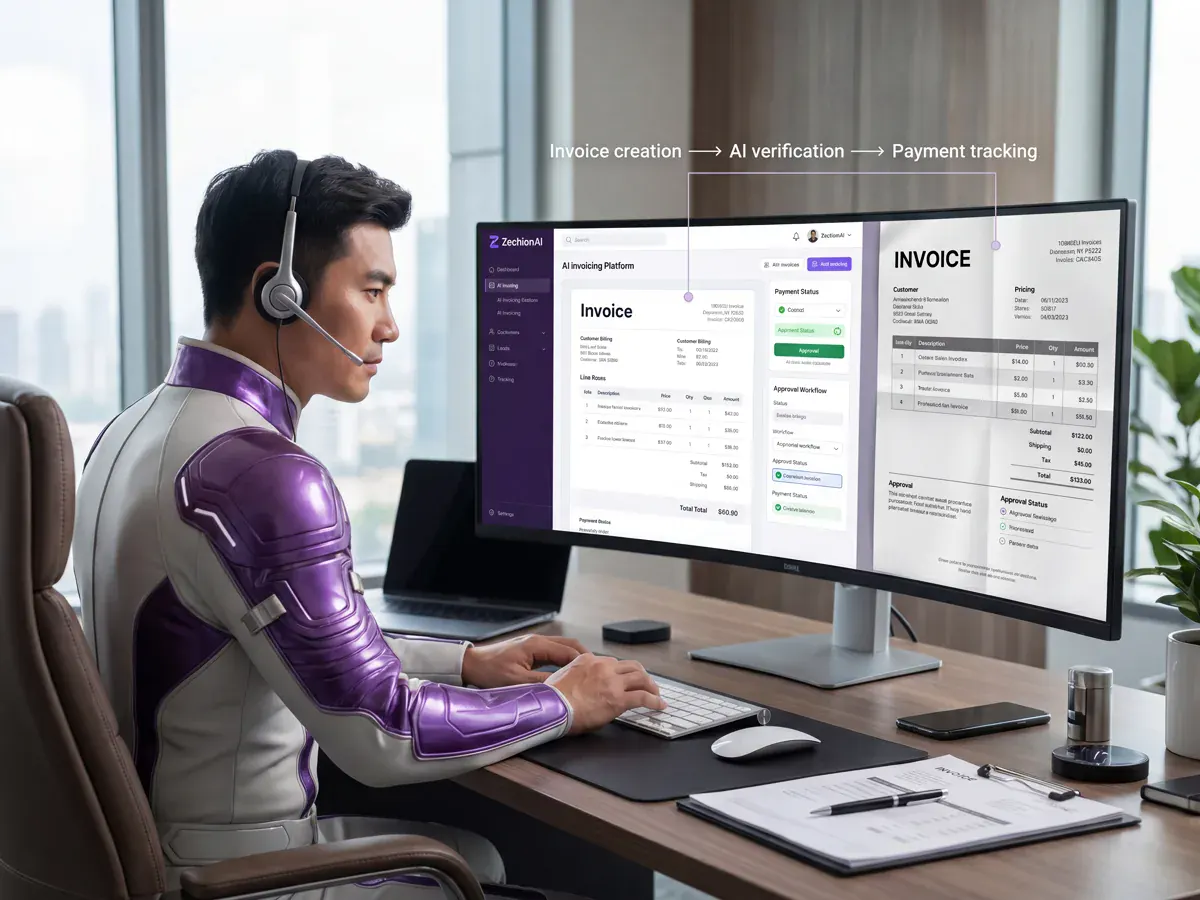 Document Processing & OCRTurn Documents Into Structured Data, Intelligent Workflows, and Actionable Information
 Intelligent AutomationAutomate Repetitive Work. Connect Your Systems. Improve How Your Business Operates.
It can include AI monitoring, maintenance, troubleshooting, model performance management, retraining, optimization, security monitoring, cost monitoring, reporting, and ongoing operational support. The exact scope depends on the selected service model.
Yes. ZechionAI can assess and support third-party or previously developed AI systems, provided the required access, documentation, technology compatibility, and responsibilities can be established.
Yes. Post-deployment management is the primary purpose of this service. We can provide monitoring, maintenance, troubleshooting, optimization, retraining, reporting, and other agreed operational functions.
Monitoring depends on the model and use case. It can include accuracy, precision, recall, drift, thresholds, prediction quality, latency, error rates, business KPIs, and other relevant indicators.
Retraining may be considered when performance declines, data changes significantly, drift is detected, business requirements change, or agreed thresholds indicate that the model should be reassessed.
Yes. ZechionAI can investigate model failures, application problems, API issues, integration failures, unexpected outputs, workflow errors, configuration problems, and other agreed production issues.
24/7 monitoring can be included for appropriate managed-service engagements. Exact coverage, alerting, response arrangements, and escalation procedures are defined in the applicable service agreement.
Depending on the environment and agreed scope, yes. Support can include AI infrastructure, APIs, application integrations, monitoring pipelines, configurations, and related operational components.
We can monitor usage, infrastructure consumption, API activity, model consumption, and cost anomalies and identify potential optimization opportunities. Actual savings depend on the environment and changes implemented.
Monthly reporting can be included in managed-service engagements. Reports may cover model health, incidents, availability, usage, costs, performance trends, and recommendations.
Yes, subject to the requirements of the engagement. Security, access, documentation, governance, data handling, and other controls can be incorporated according to the client's applicable obligations and environment.
Yes. A monitoring-focused engagement can be a practical starting point before expanding into maintenance, troubleshooting, retraining, optimization, governance, or fully managed AI operations.
Yes. Dedicated AI support teams can be structured for organizations requiring a more involved operational relationship. Team composition depends on system complexity and support requirements.
The incident is assessed according to the agreed support process. Depending on severity, the team investigates the issue, identifies the cause, coordinates remediation, escalates where necessary, documents the event, and communicates according to the applicable SLA.
Yes. Managed services do not have to replace internal teams. ZechionAI can operate alongside IT, engineering, data, security, product, and operations teams with clearly defined responsibilities.
Pricing can depend on the number of AI applications and models, monitoring scope, infrastructure complexity, integrations, support coverage, business criticality, usage volume, retraining requirements, security requirements, and SLA level.
We can support third-party models, APIs, and AI services where the relevant access, documentation, licensing, technical dependencies, and responsibilities permit it.
The issue can be investigated to determine whether the cause relates to model drift, data changes, integration issues, configuration, prompts, infrastructure, workflow design, or another factor. Depending on the findings, corrective action may include configuration changes, optimization, retraining, replacement, or additional testing.
Your AI Should Have Someone Responsible After Launch
Production AI needs more than an initial deployment.
Talk to Zech, live