
AI-Powered CRM Integration
Connect Your CRM, Customer Data, AI, and Business Systems
Talk to Zech, live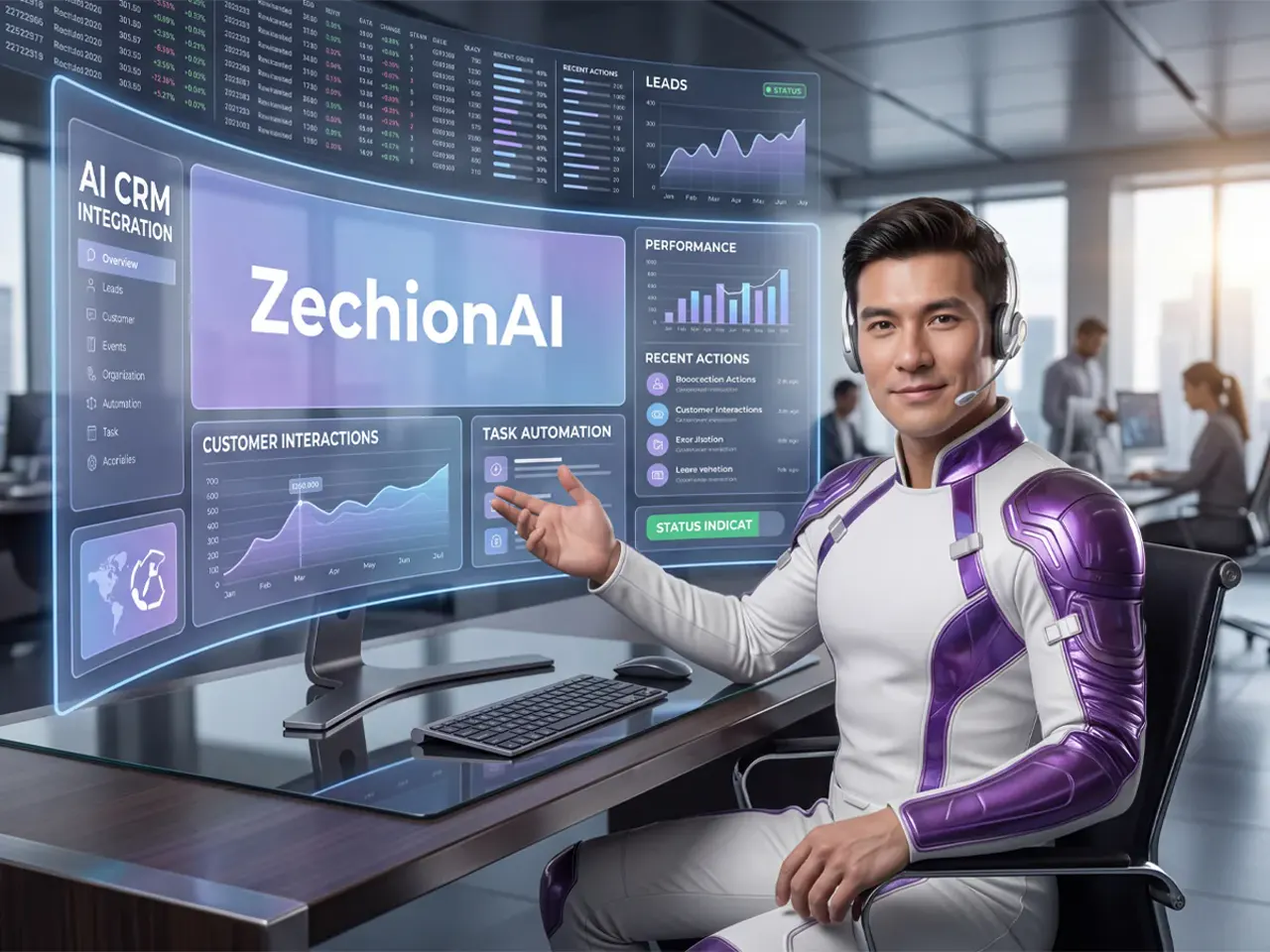
- AI CRM Strategy & Consulting
- AI Customer Data Integration
- AI Sales & Pipeline Automation
- AI Marketing CRM Integration
Your CRM must be more than just a place to store customer information. ZechionAI aids businesses and organisations connect CRM platforms to customer information enterprise applications, communications channels analytics platforms, APIs with AI-powered workflows.

We create and implement AI-powered CRM integration tools that help to reduce the number of disconnected systems, improve the visibility of data, streamline repetitive processes, and offer sales marketing, sales, and service teams better insight into the needs of customers. When you're updating an old CRM, linking various enterprise applications or incorporating AI to existing workflows, we can help transform your CRM system into a more integrated and smart business system.
AI-Powered CRM Integration Built Around Your Business
As companies grow the CRM environment is rarely simple. New software is introduced and teams are able to use different tools, and customer data moves across departments and more established integrations become more difficult to maintain.
This can result in multiple customer accounts, manually entry of data as well as a disconnect in sales and marketing data, inconsistent reporting and customer service departments working with no complete understanding of the connection.

ZechionAI aids in solving these problems in integrating your CRM to the data and systems your business already relies on. We blend CRM Integration Engineering, Data Integration AI, workflow automation, and governance to build a more integrated technology-driven environment.
Our method is pragmatic. We don't recommend AI just because it's readily available. It is first important to analyze your processes, systems as well as your data security requirements and business objectives. We then pinpoint areas where AI and integration could add value to your operational processes.
If you're a startup creating your first CRM system that is scalable or a growing company that is connecting several SaaS applications or an enterprise that is modernizing an extensive technology stack, ZechionAI can assist you in establishing an integration plan that will work for your needs.
Is Your CRM Connected to the Rest of Your Business?
CRMs can be a effective record-keeping system however its utility is limited when vital information is buried in other applications.
Common problems include:
- 01
Customer Information Scattered Across Systems
The customer's records can be found in ERP, CRM, e-commerce, support, marketing, billing, and other internal programs, which makes it challenging to create a trustworthy view of the customer.
- 02
Manual CRM Updates
Service and sales employees could be able to spend a lot of time entering data that can be synchronized, or automated.
- 03
Sales and Marketing Data Not Synchronized
If campaign responses, leads interactions with customers, campaign responses and information about opportunities don't transfer seamlessly between the systems, teams may lose perspective and be inaccessible.
- 04
Incomplete Customer Service Context
Support teams could be able to access a ticket but not the entire customer's account history the most recent purchases, messages or sales activities.
- 05
Legacy Systems That Are Difficult to Connect
Older software may use outdated interfaces or integrations that are hard to update and maintain.
- 06
Integration Complexity
As more and more applications connect with point-topoint integrations are becoming difficult to manage, troubleshoot and scale.
- 07
CRM Data Quality Problems
Duplicates, inconsistent formats inconsistencies in formats, old records, and incorrect identifiers could undermine confidence in reports for CRM as well as AI outputs.
- 08
Manual Workflows
Lead routing and follow-ups. Approvals, follow-ups, alerts, data enrichment and record update can lead to unnecessary operational burdens.
- 09
Limited Customer Intelligence
Companies may have a lot of customer data, but do not have the models, pipelines or analytics required to transform this data into valuable information.
- 10
Fragmented Customer Interactions
Chat, email, voice social, support sales and other interactions might not be tied to a consistent profile of the customer.
- 11
Inconsistent Reporting
Different teams could employ different definitions or sources This makes it difficult to comprehend pipeline performance and customer behavior and operational outcomes.
- 12
AI Without the Right Data Foundation
Businesses may wish to employ AI agents or assistants, but find that their CRM information APIs, permissions, permissions and workflows aren't ready for dependable AI use.
Our AI-Powered CRM Integration Services
ZechionAI blends CRM with AI, Data Integration + Governance and Automation to assist organizations in creating more effective customer technology environments.
AI CRM Strategy & Consulting
AI CRM projects are the most successful when they begin with a clear business plan. The services we offer for AI CRM consulting services help companies assess their current situation to identify potential opportunities and develop a roadmap for implementation prior to committing to major technological modifications.
We analyze CRM's structure as well as data processes, business processes, integrations, automation opportunities, AI readiness, security concerns, and the organizational requirements.
What We Integrate or Build
- CRM assessment
- AI readiness assessments
- CRM Integration strategies
- CRM architecture plans
- AI use-case portfolios
- Automation roadmaps
- Data strategies
- Evaluation of technology
- Integration architecture
- Implementation plans and business cases
- Roadmaps for CRM transformation
Business Outcomes
- Better technology investment decisions
- Clearer CRM modernization priorities
- More targeted AI initiatives
- Reduced complexity of integration that is not needed.
- Implementation priorities are clearly defined.
- Technology should be aligned with business goals
Example Use Cases
- Analyzing an old CRM environment
- Planning an enterprise-wide CRM consolidation
- Identifying the sales automation opportunities
- Preparing customer data for AI
- Evaluation of AI agents to provide customer service
Relevant Technology Categories
CRM platform, API structures, platforms for integration data pipelines, analytics AI/ML platforms LLMs, workflow automation, and enterprise applications.
Who Benefits Most
Companies are planning CRM upgrade, AI integration, consolidating systems or major integration projects.
CRM Platform & System Integration
The CRM is rarely operating on its own. ZechionAI connects CRM platforms to the apps that aid in the sales, marketing, operations finance commerce, service and analytics.
We create integrations in accordance with the requirements for data flows, ownership of the system, security model, transaction quantity, latency needs, and long-term maintenance.
What We Integrate or Build
- CRM-to-ERP integrations
- CRM-to-e-commerce integrations
- Marketing Platform integrations
- Support for customers integrations
- Payment system integrations
- Integrations into the communication platform integrations
- Connections to data warehouses
- Analytics integrations
- Internal application integrations
- SaaS integrations
- API-based integrations
- Webhook-based workflows
Business Outcomes
- Reduced duplicate data entry
- Better system synchronization
- Increased visibility across functional areas
- More reliable customer information
- Handoffs to manual workers are reduced.
Example Use Cases
- Customer synchronization between ERP and CRM
- The process of transferring e-commerce orders to CRM
- Update of opportunities for sales through business systems
- Linking records of customer services to account details
Relevant Technology Categories
Webhooks, REST APIs and webhooks middleware, iPaaS and event-driven architecture ETL/ELT secure data pipelines, as well as integration services.
Who Benefits Most
Companies and businesses that are growing have many applications require an efficient and reliable exchange of information.
AI Customer Data Integration
AI will only prove as effective as the data that supports it. ZechionAI aids organizations to bring customer data together, improve the quality of data, and create the foundations needed on which to build Customer 360 and AI applications.
We can assist in synchronizing customer records and normalize data, find the presence of duplicates and map-identifiers and connect unstructured and structured data when needed.
What We Integrate or Build
- Customer data pipelines
- Data synchronization
- Matching of customer identities
- Data normalization
- Deduplication processes
- Customer 360 data models
- Data enrichment workflows
- Integration of unstructured and structured data
- Data quality monitoring
- AI-ready customer datasets
Business Outcomes
- More reliable customer records
- Improved customer visibility
- Better CRM reporting
- Stronger AI data foundations
- Data quality issues are less severe
Example Use Cases
- Making a profile of the Customer 360
- Integrating CRM and transaction history
- Reconsolidating redundant customer information
- Preparing customer data for predictive models
Relevant Technology Categories
Data pipelines, ETL/ELT database, CDP structures, identities resolution data lakes, data warehouses machine learning and analytics.
Who Benefits Most
Companies with scattered customer data and multiple CRM environments or plans to implement AI customers' intelligence.
AI Sales & Pipeline Automation
Sales teams need to spend more time establishing relationships and advancing opportunities, not keeping records in a manual manner.
ZechionAI connects CRM information with AI capabilities to aid lead qualification and prospecting following-ups, sales forecasts and suggestions, and automated CRM updates.
What We Integrate or Build
- Lead scoring
- Lead Qualification workflows
- Prioritization of opportunities
- Pipeline alerts
- Automated follow-ups
- Tasks in sales automation
- Forecasting workflows
- Recommendations for the next best action
- Automated CRM updates
- Account intelligence
- Sales assistants
Business Outcomes
- Greater visibility of pipelines
- Administrative work is reduced
- Faster follow-up
- More consistent sales processes
- Better prioritization
Example Use Cases
- Prioritizing leads that are high-intent
- Generating follow-up tasks
- Summary of account activity
- Identifying opportunities that are stalled
- Sales representatives are provided with information about the account
Relevant Technology Categories
Predictive analytics, LLMs, CRM APIs, workflow automation, AI assistants, data enrichment as well as business intelligence.
Who Benefits Most
Sales companies that manage huge pipelines, complicated relationship with clients, or large volume of inbound leads.
AI Marketing CRM Integration
Marketing is a great source of data on prospects and customers However, that information is more valuable when systems for marketing and sales can operate on the same information.
ZechionAI is a platform that connects advertising automation CRM, customer data, campaigns and analytics to enable better segmentation and personalization, as well as attribution and handoffs.
What We Integrate or Build
- Lead synchronization
- Campaign data integration
- Marketing automation connections
- Customer segmentation
- Lead scoring
- Personalization workflows
- Attribution to the campaign
- Customer journey data
- Sales-to-marketing workflows
- AI-assisted campaign intelligence
Business Outcomes
- More effective marketing and sales alignment
- A more steady leadership
- Improved customer visibility
- Better analysis of the campaign
- More relevant customer engagement
Example Use Cases
- Marketing leads that are qualified for entry to CRM
- Synchronizing campaign engagement
- Triggering sales follow-ups
- Building customer segments
- Linking the campaign performance with data on revenue
Relevant Technology Categories
Marketing automation CRM APIs CDP, analytics, customer data platforms, AI models, workflow automation and pipelines for data.
Who Benefits Most
Companies with established marketing programs that have multiple acquisition channels or complicated customer journeys.
AI Customer Service Integration
Teams in customer service require the right context. ZechionAI connects CRM support, customer history, support and knowledge resources, as well as communications channels, and AI capabilities to assist team members work with more comprehensive details.
AI aids in the classification as well as routing, summarization prioritization of information, and other customer interactions, and still allow human review when necessary.
What We Integrate or Build
- Integrations with ticketing integrations
- Access to customer history
- AI-assisted support workflows
- Classification of cases
- Priority detection
- Knowledge integration
- Automated routing
- Analysis of sentiment
- Service analytics
- Escalation workflows
- Agent-assist capabilities
Business Outcomes
- A better understanding of the customer
- More consistent handling of cases
- Reduction of repetitive work
- More information is available faster
- Greater visibility of the service
Example Use Cases
- Automatically categorizing support case types
- The summation of customer conversations
- Routing cases based on specified criteria
- Agents who have relevant customer histories
- Identifying situations that might need an escalation
Relevant Technology Categories
CRM Customer support platforms, CRM NLP, LLMs, knowledge bases APIs workflow automation, and analytics.
Who Benefits Most
Companies that manage large customer support or multiple channels for customer support.
Conversational AI & CRM Integration
Conversational AI is significantly more valuable when it can safely interact with the appropriate business systems.
ZechionAI incorporates AI chatbots and voice agents with conversationsal assistants, message channels, and contact center systems into CRM environments so conversations can aid in real business workflows.
What We Integrate or Build
- AI chatbots
- AI voice agents
- Assistants to websites
- Integrations with Messaging integrations
- Contact-center integrations
- CRM data retrieval
- Updates to the CRM record
- Lead capture
- Appointment scheduling
- Summary of conversations
- Human agent handoffs
Business Outcomes
- More efficient customer interactions
- More steady lead capture
- More context for conversation
- Reduction of repetitive work
- Handoffs improved among AI humans and AI teams
Example Use Cases
- Capturing leads via the use of an AI website assistant
- Scheduling appointments
- Finding authorized customer information
- The process of capturing conversations in CRM
- Sending complex requests to human representatives
Relevant Technology Categories
LLMs, conversational AI speech technologies CRM APIs the authentication process, retrieval-augmented generation contact-center systems, as well as workflow automation.
Who Benefits Most
Companies that run websites or contact center, customers portals or other high-volume channels for communication.
Access to CRM data should be based on authorization and access to data, auditability, and the overall governance of the organization.
AI Customer Intelligence & Predictive Analytics
Data from customers can be used to support more than just historical reports. If data quality is good as well as model development, businesses can make use of analytics or machine learning in order to detect patterns and make better choices.
ZechionAI assists in integrating customer information along with prescriptive analytics along with AI technology.
What We Integrate or Build
- Customer segmentation
- Churn prediction
- Lead scoring
- Customer lifetime value analysis
- Propensity to buy
- Sales forecasting
- Analysis of customer behavior
- Information on upsells and cross-sells
- Customer health scoring
- Predictive dashboards
Business Outcomes
- Prioritizing customers better
- The earlier detection of risks earlier
- More informed sales decisions
- Better customer understanding
- Increased visibility for executives
Example Use Cases
- Identifying customers with indications of churn
- Prioritizing accounts to expand
- Forecasting sales on the basis of the patterns of past sales
- Creating customer health scores
Relevant Technology Categories
Machine learning predictive analytics statistical modeling, databases, platform for business intelligence CRM data as well as AI services.
Who Benefits Most
Organizations that have enough information from the past and a definite requirement for sales or customer intelligence.
Predictive results are based on the quality, accuracy as well as the completeness and quality of the data.
AI CRM Workflow & Agent Automation
Each workflow can be managed through the use of an AI agent. ZechionAI helps companies determine the processes that are most suitable for precise automation or AI-assisted workflows or other autonomous approaches based on agents.
What We Integrate or Build
- Workflows based on triggers
- AI agents
- Data enrichment
- Automated CRM updates
- Lead routing
- Case routing
- Approval workflows
- Notifications
- Follow-up automation
- Agent-assisted decisions
Three Practical Automation Levels
- Deterministic Automation: Workflows based on rules that can perform predictable tasks, like routing leads according to geography or assigning tasks whenever a record is changed.
- AI-Assisted Automation: AI interprets information and recommends an action while a human or a defined workflow is in charge of execution.
- Autonomous AI Agents: AI systems that execute a specific sequence of tasks within the confines of defined boundaries and with permissions.
To make processes more effective the human factor, approval by a person and handling of exceptions access control, and auditability are all possible to be integrated into the process.
Business Outcomes
- Repetitive work is less
- More reliable processes
- Faster execution
- Improved workflow visibility
- Adoption of AI agents in a controlled manner AI agents
Relevant Technology Categories
Process engines and APIs LLMs, AI agents, RPA webhooks and events-driven architecture, CRM automation.
Who Benefits Most
Organizations with repetitive, rules-driven, or information-intensive CRM processes.
Enterprise CRM & API Integration
Enterprise CRM environments typically comprise hundreds or dozens of systems, numerous data sources, old apps, platforms for identity and more complex security requirements.
ZechionAI develops integration systems that are designed with scalability and reliability, as well as monitoring, and maintaining in the back of your.
What We Integrate or Build
- API integrations using REST API integrations
- Webhook integrations
- Middleware
- iPaaS implementations
- Microservice integrations
- Event-driven architectures
- Connections to the old system
- Internal application integrations
- Data lake and data warehouse connections
- Identity system integrations
- Data flows in the enterprise
Business Outcomes
- More reliable system interoperability
- Better integration scalability
- Lower dependence on fragile point to point connections.
- Better monitoring
- Architectures that are more durable
Example Use Cases
- Connecting CRM with ERP for enterprise
- Synchronizing data across business units
- Integrating old applications with modern CRM
- Connecting CRM events to corporate workflows
- Relevant Technology Categories
- APIs, REST middleware, webhooks microservices, iPaaS streaming ETL/ELT and identity system.
- Who Benefits Most
Large enterprises, corporations multi-system environments and companies that are in the process of modernizing their technology.
CRM Data Migration & Modernization
Modernization of CRM is more than simply moving data across systems to the next. Unplanned migrations can result in the transfer of redundant, incoherent information or even outdated data to the new system.
ZechionAI explores migration as a integrated project that is structured and based on data.
What We Integrate or Build
- Data extraction
- Data profiling
- Data cleaning
- Data mapping
- Transformation of data
- Deduplication
- Data validation
- Pipelines for migration
- Consolidation of CRM
- Legacy integration replacement
- Validation of post-migration
Business Outcomes
- Cleaner CRM data
- Lower risk of migration
- More continuity
- More accurate reporting
- Modern architecture of integration
Example Use Cases
- Migration from a legacy CRM
- Consolidating several CRM systems
- Transitioning to a cloud-based CRM
- Replacing old integrations
- Preparing legacy customer data for AI
Relevant Technology Categories
ETL/ELT, data transformation APIs, databases Data quality tools CRM platforms on cloud platforms, validation frameworks and platforms.
Who Benefits Most
Companies are replacing their CRM systems by consolidating platforms or modernizing their technology stack.
CRM Security, Governance & Managed Integration
CRM integrations frequently transfer sensitive customer and business information across multiple systems. Security and governance also must be taken into consideration as part of the architecture and not added as an added feature.
ZechionAI can assist businesses in implementing the right controls on access, identity, API security, monitoring data governance, monitoring ongoing integration processes.
What We Integrate or Build
- Access control and identity
- Access control based on role
- Secure authentication
- API security
- Controls for encryption
- Audit Logging
- Data quality monitoring
- Monitoring of integration
- Monitoring performance
- Incident response processes
- Maintenance of integration
- Governance workflows
Business Outcomes
- Better control over data access
- Increased visibility of integration
- Risk reduction in operations
- More scalable integrations
- Stronger governance
Example Use Cases
- Monitoring API failures
- Limiting AI access to CRM information
- Monitoring Integration activity
- Conducting quality checks on data
- Controlling development and production environments in separate ways
Relevant Technology Categories
IAM, RBAC, OAuth, API gateways, encryption and logging, monitoring secrets management and SIEM integrations and secure practice for development.
Who Benefits Most
Enterprises, organizations that are regulated that handle sensitive information and companies operating complicated CRM systems.
For industries subject to regulation, the implementation must be in line with legal requirements, contractual obligations as well as industry-specific obligations as well as internal guidelines. ZechionAI does not claim or endorse any certification from the regulatory authorities unless explicitly verified.
CRM Platforms & Technology Ecosystem
ZechionAI uses a neutral approach to integration of CRM. We take into consideration the existing environment of the client as well as their needs, security model, budget and long-term goals, instead of forcing the use of a specific technology stack.
CRM Platforms
Integration projects can include platforms like:
- Salesforce
- Microsoft Dynamics 365
- HubSpot
- Zoho CRM
- SAP CRM/CX
- Oracle CX
- Other CRM systems for enterprises
- Custom-built CRM systems
The compatibility of APIs and platforms must be analyzed as part of the research process.
Business Systems
CRM environments can be linked to:
- ERP systems
- Platforms for HRM and HCM
- Platforms for e-commerce
- Payment systems
- Customer support platforms
- Marketing automation
- Communication systems
- Data Warehouses
- Data lakes
- Platforms for Business Intelligence
- Internal applications
Integration Technologies
Based on the needs The solutions can include:
- REST APIs
- GraphQL when it is
- Webhooks
- Middleware
- iPaaS
- ETL/ELT
- Event-driven integration
- Secure data pipelines
- API gateways
- Microservices
AI Technologies
AI-powered CRM applications may include:
- Machine learning
- Generative AI
- Large language models
- Retrieval-augmented generation
- AI agents
- Predictive analytics
- Natural processing of language
- Conversational AI
The final technology stack is contingent on the system that is in place for the client and business goals, security requirements, data environment, integration complexity and budget.
What AI-Powered CRM Integration Can Help You Achieve
A properly-planned CRM integration strategy will bring benefits to marketing, sales operations, customer service and even leadership.
- 01
Better Customer Visibility
Connect relevant information so teams are able to work with an overall view of the customer.
- 02
Reduced Manual CRM Administration
Automate the repetitive updating and routing, synchronization and other administrative processes.
- 03
Faster Lead Response
Connect Lead Capture, Qualification, routing followed-up and workflows.
- 04
More Consistent Sales Processes
Standardize the selected pipelines and account-management workflows.
- 05
Improved Data Quality
Rectify duplicates, normalize information and implement data quality controls.
- 06
Better Customer Service Context
Service teams have access to pertinent information about customers and accounts.
- 07
Faster Reporting
Link operational data with analytics systems to provide more accurate reporting.
- 08
More Intelligent Decision-Making
Make use of analytics or predictive models and AI-assisted insight where the data support them.
- 09
Improved Workflow Efficiency
Automate handoffs among teams as well as between systems.
- 10
Better Cross-Functional Collaboration
Sales and marketing, as well as service and operations to work with more reliable information.
- 11
More Scalable CRM Operations
Create integration architectures that are able to adapt as systems, users and data volumes rise.
- 12
Stronger Integration Governance
Increase the visibility of data flows and workflows, APIs, permissions and the system's performance.
Practical AI CRM Use Cases
AI Lead Qualification
Problem Sales teams receive massive quantities of leads that have varying levels of importance.
AI/Integration Solution Connect leads from lead sources to CRM and then use AI or scoring algorithms to categorize the leads and prioritize them.
Business Goal: Sales reps are able to focus their attention to leads that meet the requirements of the organization's qualifications.
Automated CRM Data Entry
- Problem: Employees spend their time updating their CRM records manually.
- AI/Integration Solution: Collect information that is derived from business processes approved by the company, and then fill in the appropriate CRM fields.
- Business Results: Less administrative work and more consistent maintenance of records.
Customer 360
- Problem: Customer data is available across CRM as well as commerce support, billing and a variety of other systems.
- Artificial Intelligence/Integration Solutions: Link the relevant data sources and create a single client data model.
- Teamwork: Businesses get an understanding of the interactions with customers and the activities.
AI Sales Assistant
The problem is that sales teams have to comb through large volumes of account data.
- AI/Integration Solution: Create An AI assistant that can retrieve relevant CRM information and outlines pertinent account activities.
- Business Goal: Faster access to context of customers and sales details.
Customer Service Copilot
Problem: Service agents must review several records prior to making a decision.
AI/Integration Solution Connect CRM records, customer history records, support case, and other approved knowledge sources to the AI assisted workflow.
The Business Outcome is that representatives are able to get access to relevant context faster.
AI Call Summarization
Problem: Conversations with customers generate notes that need to be manually in CRM.
AI/Integration Solution Processing authorized recordings or transcripts of calls and create structured summaries for review and entry into CRM.
Business Outcome: Less paperwork work and more reliable documents.
Intelligent Lead Routing
- Problem: Leads can be assigned by hand the sales departments.
- AI/Integration Solution: Mix CRM rules data, customer information, territorial information, and other AI signals to help support routing decisions.
- Results from Business: A more regular lead assignment.
Churn Prediction
- Problem: Organizations may not identify customer risk until after engagement declines.
- Artificial Intelligence/Integration Solutions: Examine pertinent historical customer data and create models that are predictive when enough information is available.
- Business Outcome: Early identification of customers that may need to be contacted.
Sales Forecasting
- Trouble: Pipeline predictions could depend heavily on manual assessment.
- AI/Integration Solution: Mix the information from CRM pipelines with historical data and techniques for predicting.
- Business Outcome: A further analytical approach to sales planning.
Personalized Marketing
- Problem: Broad-based campaigns might not be able to meet the needs of different customers.
- Integration and AI Solution: Integrate customers' profiles, segments, campaign data, and certified AI capabilities.
The Business Outcome is more personalised customer journeys as well as marketing workflows.
Automated Follow-Ups
Problem: Follow-up tasks may be delayed or missed.
AI/Integration Solution for Triggering reminders, tasks or AI-assisted communication according to workflow-specific conditions.
Business Results Improved follow-up process.
Customer Health Scoring
- Issue: The account teams might be unable to assess the health of an account.
- AI/Integration Solution: Mix relevant commercial, service, engagement and product data into a health model that is defined.
- Business Outcome: More insight into the customer relationship.
AI Appointment Scheduling
Problem: Scheduling is a regular back-andforth communication.
AI/Integration Solution Connects conversationsal AI with CRM systems that are approved and scheduling systems.
Business Results Improvement in appointment workflows.
CRM Data Enrichment
- Trouble: Records from CRM might be missing.
- Integration Solution for AI and Integration: Integrate to approved enrichment source and validate workflows, while adhering to data governance requirements.
- Results for Business: more valuable and reliable customer records.
Enterprise Workflow Automation
The problem is that complex processes usually require multiple systems and manual handoffs.
- Artificial Intelligence/Integration Solutions: Link CRM APIs Enterprise apps, workflow engines and AI capabilities to control processes.
- Business Outcome: Better efficient execution in all departments.
Industries We Serve
All industriesZechionAI assists businesses across different industries where customer relations and data, business applications and operational workflows require to be integrated.
 Healthcare & Life SciencesCommon CRM Challenges Life sciences and healthcare organizations are able to operate in complex patient/provider partners, sales service, as well as operational settings. Data could be spread across scheduling, CRM and service systems, as well as communication along with enterprise and corporate systems. AI & Integration Opportunities Integration of stakeholder and customer data; Workflows for the relationship between providers; Service coordination; Communication workflows; CRM analytics; Customer engagement automation; Enterprise application integration; Governance of data Example Use Cases Management of relationships with providers; Service request routing; Customer communication workflows; Account intelligence; CRM-to-enterprise system integration Solutions that require sensitive information should be based on the applicable security, privacy security contracts, other organizational standards.
 Financial ServicesCommon CRM Challenges Financial companies can manage complicated customer relations across marketing, service, sales onboarding, as well as account-management systems while operating within strict requirements for data and governance. AI & Integration Opportunities Customer intelligence; Management of relationships; Management of the lead; Service workflows; Customer segmentation; Predictive analytics; Secure data integration Example Use Cases Assistants to the relationship manager; Customer service automation; Lead prioritization; Analysis of health status of customers; Integration of enterprise systems and CRM
 Technology & SaaSCommon CRM Challenges Companies in the field of technology often integrate CRM and product use billing, customer satisfaction marketing, support as well as subscription and billing systems. AI & Integration Opportunities Account intelligence; Customer satisfaction automation; Product/customer data integration; Management of the lead; Lifecycle workflows for subscriptions; Predictive customer insight Example Use Cases Customer health scoring; The identification of opportunities for expansion; AI sales assistants; Automated onboarding workflows; Integration of product-data and CRM
 Retail & E-CommerceCommon CRM Challenges Retailers can collect customer information across e-commerce marketing, loyalty, CRM support, transaction systems. AI & Integration Opportunities Customer 360; Personalization; Marketing integration; E-commerce synchronization; Customer service automation; Workflows for loyalty Example Use Cases Synchronization of customer profiles; Personalized marketing segments; Customer service context; Workflows based on purchases; AI Customer assistants
 Professional & Corporate ServicesCommon CRM Challenges Professional service companies must manage clients, prospects engagements, communications and service relations across multiple business systems. AI & Integration Opportunities Management of the lead; Management of client relationships; Account intelligence; Service workflows; Communications with customers; Integration of Business applications Example Use Cases Client relationship dashboards; AI Account Summary of AI account; Lead qualification; Automated follow-up with clients; Integration of project management and CRM
 Real Estate & ConstructionCommon CRM Challenges Sales pipelines can include leads property agents, customers transactions, communications, and other project-related data. AI & Integration Opportunities Management of the lead; Property/customer data integration; Sales automation; Communication workflows; Account intelligence Example Use Cases AI Lead Qualification; Property inquiry processing is automated.; Integration between CRM and listing systems; Follow-up automation; Dashboards for customer activity
 Manufacturing & IndustrialCommon CRM Challenges Companies often require integration of CRM with ERP dealer, distributor inventory, service as well as sales and inventory systems. AI & Integration Opportunities Managerial management of dealer relationships; Account intelligence; Sales forecasting; Service workflows; Integration of ERP and CRM; Customer analytics Example Use Cases Distributor account management; Sales forecasting; Service case routing; CRM-to-ERP synchronization; Health monitoring of accounts
 Hospitality & TourismCommon CRM Challenges Information about guests and customers may be used for reservations, communications marketing, loyalty management of property, and service systems. AI & Integration Opportunities Profiles of guest/customer profiles; Booking data integration; Personalization; Service workflows; Customer engagement Example Use Cases Guest profile synchronization; AI Customer assistants; Personalized engagement; Service request routing; Integration between booking systems and CRM
 Transportation & LogisticsCommon CRM Challenges Customer relationships may include the sphere of shipments, bookings, demands and billing, operations and even communication platforms. AI & Integration Opportunities Management of customer accounts; Shipment/service workflows; Support automation; Sales pipeline management; Enterprise integration Example Use Cases Customer service automation; Account dashboards; Integration of logistics and CRM systems; Automatic service alerts; Management of sales opportunities
 EducationCommon CRM Challenges Educational institutions can control prospective students and students alumni partners, communications and enrollment workflows across several systems. AI & Integration Opportunities Prospect management of relationships; Enrollment workflows; Communications; Engagement analytics; Data integration Example Use Cases AI Admissions assistants; Routes for Lead/Prospect; Automated communication; Enrollment workflow automation; Integration between student-systems and CRM
 Energy & UtilitiesCommon CRM Challenges The information about customers and accounts can be shared across billing service, field operations communications, as well as enterprise systems. AI & Integration Opportunities Customer service; Management of accounts; Field-service-related workflows; Enterprise integration; Customer analytics Example Use Cases Service request routing; Customer account intelligence; Integration of operational systems and CRM; AI Service assistants
 Government & Public SectorCommon CRM Challenges Public sector organizations can manage customer interactions and service requests cases, information about the case, communications, as well as multiple administrative systems. AI & Integration Opportunities Constituent/customer service; Case management; Communication workflows; Data integration; Auditability and governance Example Use Cases Service request routing; Constituent communication workflows; Case summary; Integration of administrative and CRM systems; Customer service assistants Implementations in the public sector should consider relevant procurement, security, privacy, accessibility records-management and the requirements of regulatory agencies.
Our CRM Integration Approach
Technology integration is best when it starts by understanding the business, not an API list.
- 01
Discovery & Business Assessment
We are aware of your goals team, processes and systems, as well as your pain points customer journeys, as well as the desired results.
Insight: Business requirements and workflows, stakeholders prioritization, constraints and priorities.
- 02
CRM & System Audit
We analyze your CRM system, its connected applications and APIs for data, data sources and the current integrations, automation, and possible technical limitations.
In Focus: Current-state architectures and integration dependency, the quality of information and debt to technology.
- 03
Data & Integration Architecture
We specify how information can transfer between systems, and the location where data should be kept and transformed, synchronized or analysed.
Attention: APIs, data flows patterns for integration, security, scalability, and maintainability.
- 04
AI Use-Case Prioritization
We determine instances where AI can be of value and differentiate AI potentialities from workflows handled by conventional automation.
The focus is on business value and data availability, feasibility, risk management, as well as work to implement.
- 05
Integration & Development
We develop and configure the necessary integrations Data pipelines and workflows AI abilities, APIs and other components.
Priority: Implementation and system interoperability, automation, and controlled AI integration.
- 06
Testing & Security Validation
We test data flow business rules APIs, workflows, failure scenarios, permissions and other relevant security controls.
The focus is on reliability in security of data Authorization, handling of errors and operational preparedness.
- 07
Deployment & Training
We help with deployment and assist teams in understanding the latest processes, AI capabilities, operational procedures, and administration needs.
Priority: Adoption of documentation, training and controlled implementation.
- 08
Monitoring & Continuous Optimization
Integration environments require continuous monitoring. We are able to monitor performance and issues with data quality, failures, API activity, automation and the ever-changing business needs.
Priority: Maintenance Optimization, troubleshooting, scalability as well as continuous improvement.
Why Outsource AI-Powered CRM Integration to ZechionAI?
- 01
AI + CRM Expertise
ZechionAI offers AI capabilities to CRM integration Data development, automation, and enterprise technological considerations.
- 02
Practical Business-First Approach
We begin with the business issue and the desired result, instead of recommending technology merely because it's new.
- 03
Integration Across the Technology Stack
We can help you connect CRM platforms to enterprise software APIs Data platforms, communication systems, as well as operational workflows.
- 04
Flexible Engagement Models
Our strategy can help startups, small and medium-sized companies, expanding organizations, and larger enterprises.
- 05
Security & Governance Mindset
Access controls and authentication data governance, monitoring, auditability, as well as suitable security procedures are viewed as components of the integration framework.
- 06
Vendor-Neutral Recommendations
The best solution is dependent on the technology you have in place and your goals. We concentrate on the requirements rather than imposing one platform.
- 07
Scalable Architecture
Integration solutions must be developed with the future in mind, such as more systems, users workflows, volumes of data along with AI capabilities.
- 08
Human + AI Workflows
AI is not required to replace all human decisions. We develop workflows in which automation and AI are able to assist employees while ensuring the human element when needed.
- 09
Ongoing Support
CRM integrations require maintenance when APIs are changed and business processes change as data volumes rise and new software is introduced. Continuous monitoring and optimization could be part of the service.
- 10
U.S. Market Focus
ZechionAI assists organizations that operate on the U.S. market and understands the importance of implementing the right solution, security considerations, integration requirements, procurement processes as well as operational scalability.
Who Should Consider AI-Powered CRM Integration?
AI-powered CRM integration could be a good option if your company:
- It is growing quickly and introducing new applications
- Has several disconnected business systems
- Are you replacing a CRM that was in use for a long time?
- Has fragmented customer data
- Rely heavily on manual updates for CRM
- Needs to increase sales efficiency
- Needs a better synchronization of marketing to sales
- Customers want customer service teams to be better informed
- Are you the AI assistant or AI agent being evaluated? AI aids, or AI agents?
- Are you consolidating multiple CRM systems?
- Are you modernizing your old integrations
- We want to create Customer 360 capabilities
- Is preparing customer data for predictive analytics
- The integration process requires more monitoring and oversight
The best starting point need not necessarily require a massive implementation. The initial step is to conduct an assessment which identifies what needs to—and must not be automated or integrated.
Engagement Models
CRM Integration Assessment
A targeted effort to comprehend your current surroundings, determine opportunities for integration, as well AI possibilities, as well as create an action plan.
The best option is for organizations who require clarity prior to the implementation.
Project-Based Integration
An established implementation that is characterized by particular integrations, automation, data, or AI deliverables.
Ideal for: Companies that have clear technical needs.
AI CRM Transformation
A multi-phased program that covers the modernization of CRM, integration with data automation, AI capabilities, and governance.
Best for: Organizations pursuing broader CRM transformation.
Managed CRM Integration
Continuous monitoring maintenance, troubleshooting, optimization and integration support.
The best option is for organizations who require ongoing operational support.
Dedicated Integration Team
Long-term Engineering as well as AI integration resources are aligned to your own internal technology team.
The best choice is for organizations with continuous integration and modernization needs.
Potential Deliverables
The scope of a project will determine the deliverables could comprise:
- CRM integration strategy
- Assessment of the current state of architecture
- Target-state architecture
- The integration roadmap
- API integrations
- Middleware or IPaaS configuration
- Data mapping
- Data pipelines
- Data transformation workflows
- CRM data migration
- Workflow automation
- AI use-case implementation
- AI agents or assistants when they are
- Predictive analytics capabilities
- CRM dashboards
- Monitoring integration
- Security controls
- Configurations for access control
- Technical documentation
- Testing documentation
- Deployment Support
- Training materials for users
- Recommendations for continuous optimization
Deliverables are defined in accordance with the environment of the client, its objectives and scope as well as the implementation specifications.
Measuring CRM Integration Success
CRM integration must be evaluated against a predetermined baseline, instead of generic promises.
According to the type of project, helpful KPIs may be:
Data Quality
- CRM data completeness
- Rate of duplicate records
- The accuracy of data synchronization
- Data validation success rate
Sales
- Lead response time
- Pipeline velocity
- Conversion rate
- Accuracy of forecasts
- Efficiency of sales activity
Adoption
- CRM adoption
- Workflows and workflows are adopted
- AI assistant usage
- User engagement
Automation
- Manual task reduction
- Automatization rate
- Rate of completion of workflow
- Human intervention rate
Customer Service
- Customer service response time
- The accuracy of the case routing
- The efficiency of the workflow for resolution
- Customer engagement
Integration Operations
- Integration uptime
- API error rate
- Rate of failed transactions
- Processing latency
- Data pipeline reliability
Business Intelligence
- Customer engagement
- Customer health
- Conversion performance
- Accuracy of forecasts
- Timelines for reporting
The right KPI set is to be established by analyzing your company's base, its the business's priorities, availability of data and desired results.
Security, Privacy & Governance
Connecting CRM systems requires connecting to data. Security and governance needs to be built to be integrated into the process rather than being treated as an extra consideration.
ZechionAI can be incorporated with appropriate controls for:
AI-powered CRM integration links the CRM platform to the business system, customer data, automation workflows, analytics along with AI capabilities. It lets information move between the various systems, while allowing AI-powered processes like lead qualification and customer intelligence, as well as service assistance, summarization as well as workflow automation.
Traditional CRM integration concentrates on connecting the systems and synchronizing data. AI CRM integration can add features like predictive analytics and natural-language interfaces AI assistants smart classification, suggestions and AI-assisted workflows when they are of practical use.
ZechionAI works with a variety of platforms like Salesforce, Microsoft Dynamics 365, HubSpot, Zoho CRM, SAP CRM/CX, Oracle CX and various other custom or enterprise CRM environments. The method of integration you select will depend on the capabilities of the platform APIs available, security models, as well as the business requirements.
Yes. Salesforce is able to be integrated with ERP marketing, customer services, e-commerce, analytics, internal applications, data platforms and many other systems by using middleware, APIs webhooks, iPaaS, or any other patterns of integration.
The specific architecture depends on the system that is connected as well as the necessary data flow.
Yes. A custom CRM could integrate with AI capabilities using APIs such as databases, middleware secure data services and application-level integrations. We first analyze the custom system's architecture, the interfaces that are available and data models as well as authentication methods and security needs.
Yes. CRM-to ERP integration is a typical scenario for enterprise integration. According to the needs such as customer, order product, account and inventory information, as well as billing or any other data can be transferred between systems.
Yes. Marketing automation can be integrated with CRM to sync leads campaigns, engagement with customers, segments, attribution data as well as marketing-to-sales workflows.
It could, provided that the workflow is properly designed and authorised. AI-generated information shouldn't change records that are sensitive or have high-impact without taking into account validation of permissions, rules for business and requirements for human approval.
For many tasks it is the mix with AI interpretation and precise workflow execution gives greater control.
It is true that conversational AI could be developed to access the CRM information that is authorized through controlled APIs and other integration layers. Access must be controlled by permissions, identity and the scope of data, logging, along with security controls.
AI agents are able to carry out certain CRM tasks like recording or updating data creating workflows, establishing workflows and routing leads, creating summary reports, or creating follow-up actions.
The level of autonomy is determined by the danger and potential magnitude of the task. High-impact activities may require approval from a human or other controls.
Security architectures can incorporate authentication authorization, authorization as well as role-based access security APIs that are secure audit logs, separation of the environment surveillance, minimization of data and other security measures that are appropriate for the particular project.
The precise controls are contingent on the systems of the customer and data, contractual requirements and the applicable laws.
Yes. CRM migration may include data extraction, profiling cleansing mapping, transformation deduplication, validation post-migration verification, and migration.
Planning for migration is crucial since transferring data of poor quality into an entirely new CRM may simply move existing problems into a brand new setting.
There isn't a universal timeframe. A simple SaaS integration could be restricted in its scope, whereas the transformation of an enterprise CRM that requires various systems, legacy applications as well as data migration security requirements and AI capabilities could require multiple stages.
The timeline is based on the complexity of the system the quality of data, integration number the scope of testing and stakeholder accessibility.
Costs are based of the CRM system, the number of systems, the complexity of integration and data volume AI demands, security needs, customization and the ongoing support requirements.
A targeted integration assessment could aid in defining the scope prior to making a budget for implementation.
Yes. CRMs do not always require replacement to improve integrations as well as AI features. We can review the current implementation and pinpoint possibilities to improve the flow of data, automation, AI functionality as well as governance, architecture and.
Yes. Multiple CRM systems may be integrated or consolidated based on the business needs. The structure could involve the synchronization of data, data consolidation middleware, master-data strategies or a phased modernization of CRM.
Yes. The ongoing services include monitoring integration maintenance, troubleshooting performance optimization, data-quality monitoring, API updates, workflow adjustments, and ongoing AI integration assistance.
Yes. AI CRM consulting can be used to analyze processes and data, discover possible use cases, evaluate feasibility as well as prioritize opportunities. make a plan prior to the implementation.
It could be. Smaller businesses do not need to require a complicated enterprise architecture. A targeted integration could connect the CRM to a handful of essential systems and automate valuable workflows without adding unnecessary complications.
Yes. Enterprises typically have a lot of opportunities to integrate CRM because they are able to integrate across multiple departments, applications and business units, as well as data sources and customer channels.
Enterprise implementations generally require greater care for design, security and identity oversight, governance scalability and management of change.
Turn Your CRM Into a More Connected, Intelligent Business System
Your CRM must be in line with the way that your business is run, not become an isolated software that teams must deal with.
Talk to Zech, live