AI Solutions for Logistics & Supply Chain
Smarter routing. Better forecasting. Clearer shipment visibility.
Talk to Zech, live

- Transportation & Logistics
- Delivery & Distribution
- Industry Supply Chains
ZechionAI helps logistics and supply chain organizations improve how goods move, how demand is planned, and how operational decisions are made.

AI to the World Your Supply Chain Operates In
From AI route optimization and demand forecasting to automated shipment tracking, predictive analytics, intelligent automation, and AI agents, we design solutions around the systems, workflows, and performance goals already driving your operation.
Logistics teams have to deal with variables that are constantly shifting: order volumes, delivery windows, traffic conditions, vehicle capacity, availability of drivers, carrier performance, inventory levels and unforeseen disruptions.
The challenge is never a lack of data. It is making the data count for timely operational decisions.
ZechionAI enables organisations to integrate real-time data with actionable AI capabilities which can assist in:
- More efficient routes and dispatching.
- More reliable demand forecasts
- Prompt notifications of shipment delays
- Improved fleet utilization
- Lower unnecessary mileage
- Improved shipping processes
- Faster customer communication
- Improved stock and space management
- Greater operational visibility
- Informed supply chain decisions.
The idea is simple: improve logistics operations to be more predictable, responsive, and efficient – without adding unnecessary complexity.
Typical Logistics & Supply Chain Issues
It can be easy for operational inefficiencies to build up through transportation, warehousing, distribution and delivery.
- 01
Teams that change so rapidly that routes change too
When delivery windows, traffic, vehicle size, driver availability and priority shipments vary during the day, manual route planning becomes a complex task.
- 02
Rising Transportation Costs
Too many miles, poor scheduling, empty miles, fuel usage, and vehicle utilization can be costly on each and every delivery.
- 03
Unpredictable Demand
Seasonal variations, geographic demand, customer usage, promotions and unusual ordering patterns may not be accounted for by historical averages.
- 04
Limited Shipment Visibility
It can take teams several attempts to find a shipment using multiple carrier systems, portals, spreadsheets, or tracking systems.
- 05
The delays which have been uncovered are too late
When an exception isn't caught early, a seemingly good shipments turns into an operational and/or customer-service issue.
- 06
Manual Administrative Work
A lot of time can be spent updating on shipments, processing documents, sending customer updates, scheduling, checking status, and handling exceptions.
- 07
Disconnected Operational Data
There can be valuable information in TMS, WMS, ERP, fleet systems, GPS platforms, telematics, order systems and carrier data – all of which can be challenging to analyze together.
- 08
Slow Decision-Making
Managers spend more time collecting information and less time using it to take action, when it's not available or is late.
How ZechionAI Helps
ZechionAI's logistics AI is not just a technology project but a transformation of operations.
We evaluate the potential for creating practical value from AI, develop the solution, integrate it with your current tech stack, and provide support following implementation.
- 01
Discover
Be aware of your logistics model, workflows, systems, data sources, KPIs and operating limitations.
- 02
Assess
Look for opportunities to use AI to solve measurable business problems at high dollar value.
- 03
Strategize
Create a realistic AI roadmap with business priorities, implementation readiness, expected value and available data.
- 04
Design
Outline the solution architecture, data flows, AI models, workflows, interfaces, integrations, and human oversight.
- 05
Build
Create the necessary models, applications, AI agents, dashboards, automation, and supporting infrastructure.
- 06
Integrate
Integrate AI functions into existing operational systems of your teams.
- 07
Deploy
Implement validated solutions to production with appropriate controls, monitoring and user workflows.
- 08
Automate
Minimize manual repetitive tasks, but retain human judgement and approval when needed.
- 09
Monitor
Monitor data quality, model performance, system health and business KPIs.
- 10
Optimize
Continue developing the solution as operational requirements, data and business needs evolve.
- 11
Scale
Expand current capabilities to more fleets, warehouses, routes, locations, carriers, or business units.
Core AI Solutions for Logistics & Supply Chain
3 services
AI Route Optimization

Planning the route is much more complicated if the operation has more than one vehicle, more than one stop, delivery windows, capacity constraints, traffic conditions, driver schedules and priority shipments.
Capabilities
- Dynamic route planning
- Multi-stop route optimization
- Delivery-window optimization
- Traffic-aware routing
- Vehicle capacity constraints
- Driver availability consideration
- Distance optimization
- Fuel-consumption considerations
- Priority-delivery management
- Last-mile optimization
- Multi-vehicle dispatch
- Real-time route adjustments
- Route deviation detection
- ETA prediction
- Emergency delivery prioritization
ZechionAI can build route optimization solutions that take all these factors into account, and suggest effective routing and dispatching decisions.
Business Value
To help organisations, better route decisions can be made by:
- Reduce unnecessary mileage
- Control fuel expenditure
- Improve vehicle utilization
- Boost deliveries accomplished per route
- Reduce avoidable delays
- Improve driver productivity
- Deliver more information to customers about delivery services.
This optimization method can be tailored to the specific operating requirements of the organization and not be viewed as a one-size-fits-all approach to the delivery routing problem.
AI Demand Forecasting
Demand varies across product, place, customer, time of year, promotions, lead time and market conditions.
Forecasting Capabilities
- Historical order analysis
- Seasonal demand analysis
- Geographic demand forecasting
- Customer purchasing patterns
- Product-level forecasting
- Promotional impact analysis
- Lead-time analysis
- Inventory demand prediction
- Demand anomaly detection
- Short-term forecasting
- Medium-term forecasting
- Long-term planning
- Forecast confidence levels
ZechionAI designs forecasting solutions that leverage historical and operational data to enable companies to better predict their future needs and allocate resources accordingly.
Planning Applications
Forecasting insights can be used to assist with:
- Inventory planning
- Procurement
- Warehouse capacity planning
- Workforce planning
- Fleet planning
- Supplier coordination
- Distribution planning
- Shipment-volume planning
Forecast should be used as a planning tool that reflects a range of possibility, rather than a certainty of what will happen in the future. ZechionAI can provide a way for teams to understand the level of confidence in the forecast and to include the human element in planning decisions.
Automated Shipment Tracking

Shipment visibility shouldn't require the constant logging in and out of several systems during the day.
Shipment Intelligence Capabilities
- Shipment status monitoring
- Automated ETA updates
- Delay detection
- Exception alerts
- Carrier performance monitoring
- Shipment milestone tracking
- Automated customer notifications
- Delivery confirmation
- Proof-of-delivery workflows
- Escalation workflows
- Shipment tracking dashboards
- Shipment anomaly detection
ZechionAI can automate shipment monitoring and pinpoint key events, enabling logistics teams to concentrate on exceptions instead of routine status checks.
What This Changes
Rather than asking questions:
Where is the shipment now?
Teams can progress towards:
“What are the immediate priorities of the shipments and why?”
The change can help to decrease the amount of manual tracking that goes on, and provide greater visibility for operations teams and customers.
All-in-One AI Services for Logistics & Supply Chain
ZechionAI can be used in isolation for a specific AI initiative or as a part of a larger AI environment around logistics.
AI Strategy & Consulting
- AI readiness assessment
- Logistics process assessment
- AI opportunity identification
- Business case development
- AI roadmap development
- ROI and KPI planning
- Data readiness assessment
- AI implementation planning
We assist with the decision-making process of where AI will make business sense prior to development.
Route & Fleet Intelligence
- Route optimization
- Fleet utilization analytics
- Driver performance analytics
- Fuel optimization
- Dispatch optimization
- ETA prediction
- Fleet demand forecasting
- Vehicle capacity analysis
- Route performance analytics
Demand & Supply Forecasting
- Demand forecasting
- Shipment-volume forecasting
- Inventory demand prediction
- Capacity forecasting
- Seasonal forecasting
- Predictive planning
- Demand anomaly detection
- Forecast performance monitoring
Shipment Intelligence
- Automated shipment tracking
- ETA prediction
- Delay prediction
- Shipment exception management
- Carrier monitoring
- Delivery-status automation
- Shipment anomaly detection
- Proactive customer notifications
Intelligent Logistics Automation
To automate repetitive aspects of operations with appropriate human review and approval points.
Services can include:
- Automated dispatch workflows
- Shipment notifications
- Document processing
- Order processing
- Scheduling automation
- Workflow orchestration
- Exception escalation
- Approval workflows
- Data-entry automation
AI Agents for Logistics Operations
AI agents can provide assistance with specific logistics processes, including information retrieval, condition analysis, defined action, and escalation.
Shipment Tracking Agent
Tracks shipment details and identifies shipment status changes and notifies about shipments in need of attention.
Dispatch Agent
Assists dispatch teams with route, vehicle, driver, and delivery information when making scheduling decisions.
Customer Support Agent
Responds to routine questions about the status of shipments and supplies information from approved operational data.
Delivery Exception Agent
Recognizes or detects delays or unusual occurrences and refers them to the appropriate team.
Logistics Operations Agent
Assists operations staff with retrieval of information, summarising KPIs, exception analysis and assisting with day-to-day decision making.
Carrier Coordination Agent
Supports Carrier State Checks, Shipment Data, Documentation and specified coordination processes.
Supply Chain Analyst Agent
Supports analysts in analyzing operational data, finding trends and patterns and producing management reports.
AI agents should not operate without human oversight – every process should have a defined permission, workflow, escalation and human overarching controls.
Conversational AI for Logistics
Make it even easier for customers, drivers and operations teams to access information.
Customer Shipment Assistant
Answer routine questions about:
- Shipment status
- Estimated delivery time
- Delivery milestones
- Delays
- Delivery instructions
Internal Logistics Assistant
Help employees find:
- Shipment information
- Route details
- Operational KPIs
- Carrier information
- Process documentation
- Exception details
Driver Support Assistant
Ensure that access to information is available, including information approved by the Board:
- Assigned deliveries
- Route instructions
- Delivery requirements
- Operational procedures
- Support requests
Operations Knowledge Assistant
Support teams to find internal logistics knowledge, policies, procedures and internal operational information.
Predictive Analytics for Logistics
Predictive analytics can enable teams to shift from looking back at past events to figuring out what might need to be addressed next.
ZechionAI will be able to acquire predictive capabilities for:
- Delivery delays
- Shipment risks
- Demand
- Capacity requirements
- Transportation costs
- Carrier performance
- Fleet demand
- Inventory requirements
- Operational anomalies
The goal is not just to make forecasts. It is to relate forecasts to real-world decisions and processes.
Computer Vision for Logistics & Warehousing
Operational information can also be derived from visual data.
Potential applications include:
- Package inspection
- Barcode recognition
- Warehouse monitoring
- Pallet detection
- Damage detection
- Loading verification
- Inventory visibility
- Package counting
- Safety monitoring
- Receiving inspection
Computer vision solutions are customized to the organization's cameras, workflows, environment and inspection needs.
Document AI & OCR
Documents are critical to logistics operations.
By using document intelligence and OCR technologies, ZechionAI can extract, classify, validate and route information from documents like:
- Bills of lading
- Proof of delivery
- Invoices
- Shipping documents
- Purchase orders
- Customs documents
- Freight documentation
- Delivery receipts
This extracted data can be used to inform operational systems and workflows, providing opportunities for validation and appropriate human oversight.
Data & Analytics
Convert inaccessible bits of operational data into dashboards and decision support.
Analytics Services
- Logistics dashboards
- Supply chain dashboards
- Fleet dashboards
- KPI monitoring
- Real-time operational reporting
- Predictive analytics
- Executive reporting
- Exception dashboards
- Performance trend analysis
Dashboards can be tailored for different levels of access and detail for executives, operations team, fleet managers, warehouse managers and analysts.
AI Integration Services
ZechionAI can integrate the capabilities of AI with existing systems that are helping your operation.
The possible integration locations are:
- Transportation Management Systems (TMS)
- Warehouse Management Systems (WMS)
- ERP systems
- CRM platforms
- Fleet management systems
- GPS platforms
- Telematics
- IoT systems
- E-commerce platforms
- Order management systems
- Carrier systems
- Customer portals
- APIs
- Databases
- Cloud platforms
The aim is to introduce useful intelligence to the existing technology landscape, without forcing an unneeded system change.
Managed Services for MLOps & AI
After deploying an AI system, it needs continuous care.
ZechionAI can provide:
- Model monitoring
- Performance monitoring
- Data-quality monitoring
- Model retraining
- Model optimization
- System maintenance
- AI support
- Security monitoring
- Performance evaluation
- Continuous improvement
As volumes and routes grow, customer behavior changes, carrier performance shifts and requirements shift, it helps organizations keep their operations of AI reliable.
The Logistics & Supply Chain Segments We Serve are as follows
ZechionAI can customize AI solutions to cater to various logistics operating models, data environments, and business goals.
Transportation & Logistics
- Freight and transportation
- Trucking and fleet operations.
- Third-party logistics (3PL)
- Fourth-party logistics (4PL)
- International freight and shipping
Delivery & Distribution
- Courier and parcel delivery
- Last-mile delivery
- E-commerce logistics
- Warehousing and distribution
- Wholesale distribution
- Retail distribution
Industry Supply Chains
- Manufacturing supply chains
- The logistics of food and beverages.
- Pharmaceutical and health care logistics.
- Automotive supply chains
- Construction supply chains
- Cold chain logistics
The architecture may be customized for the organization's fleet model, its warehouse size, its transportation network, its technology infrastructure, its data readiness, and priorities.
Business Outcomes That Matter

The implementation of AI should, in the end, enhance quantitative aspects of the operation.
ZechionAI can provide organizations with strategies for improvements on:
Transportation
- Transportation cost
- Cost per mile
- Empty miles
- Fuel consumption
- Route efficiency
- Fleet utilization
Delivery
- On-time delivery
- Average delivery time
- ETA accuracy
- Shipment exception rate
- Delivery reliability
Supply Chain
- Forecast accuracy
- Inventory turnover
- Stockout rate
- Excess inventory
- Capacity planning
Operations
- Manual processing time
- Customer response time
- Shipment visibility
- Exception response time
- Operational reporting speed
Actual results will be contingent on the organisation's starting point, data quality, operating model, implementation scope and adoption.
From AI Strategy to Production
- 01
Discover
You find out the workings of your operation, systems that help it, sources for information, and time and visibility lost by teams.
- 02
Assess
Assess data availability, technology limitations, and opportunities for AI.
- 03
Strategize
Use Cases are prioritized based on Business, Feasibility, Risk and Requirements.
- 04
Design
We determine the solution architecture, data pipeline, and AI approach, workflow, integrations, user experience and governance requirements.
- 05
Build
We create the necessary Artificial Intelligence applications, agents, dashboards, integrations and automation.
- 06
Integrate
The solution is integrated with any relevant TMS, WMS, ERP, GPS, telematics, carrier or order management system, or other system.
- 07
Deploy
The solution is validated and then we deploy it in to production with controls and monitoring.
- 08
Monitor
System performance, data quality, model behaviour and business KPIs are tracked.
- 09
Optimize
We continually improve the solution as it is put into operation, new information becomes available, and business requirements evolve.
- 10
Scale
Once a use case demonstrates value, the capability can be extended to additional locations, fleets, warehouses, routes, or business units.
Why Outsource Logistics & Supply Chain AI to ZechionAI?
- 01
Access to Specialized AI Expertise
Building logistics AI requires more than general software development. It may involve machine learning, optimization, predictive analytics, data engineering, automation, integration, and operational knowledge.
Outsourcing provides access to those capabilities without requiring an organization to build every specialty internally.
- 02
Lower Development Overhead
Organizations can avoid maintaining a large specialized AI team for every initiative while still accessing the expertise required for specific projects.
- 03
Faster Implementation
An experienced implementation partner can establish a structured path from business problem to production rather than starting each AI initiative from scratch.
- 04
Existing-System Integration
AI does not have to mean replacing your TMS, WMS, ERP, fleet platform, or other core systems. ZechionAI can design solutions around your existing environment where practical.
- 05
Flexible Engagement
Start with one use case, such as route optimization or shipment monitoring, or pursue a broader AI transformation program.
- 06
Continuous Optimization
Production AI needs monitoring, evaluation, data-quality checks, retraining, and refinement. ZechionAI can remain involved beyond the initial deployment.
- 07
Scalable AI Capability
A focused project can become the foundation for additional AI capabilities once the organization has established the required data, integrations, governance, and operational processes.
Why Partner with ZechionAI?
- 01
End-to-End AI Capability
From strategy and data assessment through development, integration, deployment, and ongoing optimization.
- 02
Logistics-Focused Solution Design
Solutions are designed around operational realities such as routes, capacity, delivery windows, inventory, shipment exceptions, and fleet performance.
- 03
Business-First Approach
Technology decisions are connected to operational objectives and measurable KPIs.
- 04
Custom Development
Solutions can be designed around your workflows, systems, data, and requirements rather than forcing every operation into a standard package.
- 05
Existing-System Integration
AI capabilities can work with your current TMS, WMS, ERP, fleet, telematics, and other platforms where technically appropriate.
- 06
Predictive Intelligence
Use forecasting and predictive models to identify patterns, risks, and future requirements.
- 07
Intelligent Automation
Automate repetitive work while maintaining appropriate approval and escalation controls.
- 08
AI Agents
Develop purpose-built agents for shipment tracking, dispatch support, customer service, exception management, and operational analysis.
- 09
Computer Vision & Document Intelligence
Apply visual inspection and document processing to warehouse and transportation workflows.
- 10
MLOps & Monitoring
Maintain model and system performance after deployment rather than treating implementation as the end of the project.
- 11
Security-Conscious Architecture
Design access controls, data protection, auditability, and monitoring into the solution architecture.
- 12
Flexible Engagement
Work with ZechionAI on a single use case, a multi-stage implementation, or a broader AI transformation program.
- 13
Long-Term Support
Continue improving the solution as operational requirements, data, systems, and business priorities change.
Technology Capabilities
ZechionAI can work across the AI and data lifecycle, including:
- Machine Learning
- Generative AI
- Large Language Models
- AI Agents
- Predictive Analytics
- Optimization Algorithms
- Computer Vision
- Natural Language Processing
- OCR & Document AI
- Data Engineering
- APIs
- Cloud AI
- Data Warehousing
- MLOps
- AI Monitoring
- AI Security
- Model Evaluation
- Workflow Automation
The technology selected should follow the business requirement—not the other way around.
Integration & Data Ecosystem
Logistics AI becomes more useful when it can access the information already generated by the operation.
ZechionAI can design integration strategies around:
- ERP
- TMS
- WMS
- CRM
- Fleet management platforms
- GPS
- Telematics
- IoT
- E-commerce platforms
- Order management systems
- Warehouse systems
- Carrier platforms
- Customer portals
- APIs
- Databases
- Cloud environments
Where appropriate, data can be brought together through APIs, integration services, data pipelines, or other architecture patterns suited to the client's technology environment.
The principle is simple: improve the intelligence around existing operations before considering unnecessary system replacement.
Security, Governance & Responsible AI
Operational data can contain commercially sensitive information. AI implementations should therefore include appropriate controls from the beginning.
ZechionAI can incorporate:
Measuring AI Performance
Before implementation, ZechionAI can help establish a baseline against which the solution can be evaluated.
Potential KPIs include:
| Area | Example KPI |
|---|---|
| Transportation | Cost per delivery |
| Transportation | Cost per mile |
| Fleet | Fleet utilization |
| Fleet | Empty-mile percentage |
| Fuel | Fuel consumption |
| Routing | Route efficiency |
| Delivery | On-time delivery rate |
| Delivery | Average delivery time |
| Delivery | ETA accuracy |
| Shipment | Exception rate |
| Area | Example KPI |
|---|---|
| Forecasting | Forecast accuracy |
| Inventory | Inventory turnover |
| Inventory | Stockout rate |
| Operations | Manual processing time |
| Customer Service | Response time |
| Visibility | Shipment visibility rate |
The appropriate KPI set depends on the use case and should be agreed upon before deployment.
Real-World Logistics AI Use Cases
Delivery Fleet
A delivery company needs to plan daily routes across multiple vehicles while considering capacity, delivery windows, traffic, driver availability, and priority orders.
An AI route optimization system can evaluate these constraints and provide dispatch recommendations that can be adjusted as conditions change.
Distribution Business
A distributor experiences different order volumes by product and location throughout the year.
Demand forecasting can help planners anticipate likely demand patterns and make better-informed inventory, warehouse, procurement, and distribution decisions.
3PL Provider
A 3PL manages shipments across multiple carriers and needs greater visibility into exceptions.
Automated shipment monitoring can collect status information, identify potential delays, and alert the appropriate team when intervention is needed.
E-commerce Logistics
An e-commerce operation wants customers to receive more useful delivery information.
AI can combine shipment events, historical transit patterns, and operational information to support ETA estimates and proactive delay notifications.
Warehouse
A warehouse wants to improve receiving and inspection processes.
Document AI can extract information from shipping documents, while computer vision can support package, pallet, or damage inspection and predictive analytics can provide additional operational visibility.
AI services for Logistics & Supply Chain
- Predictive AnalyticsTurn Historical and Real-Time Data Into Better Business Decisions
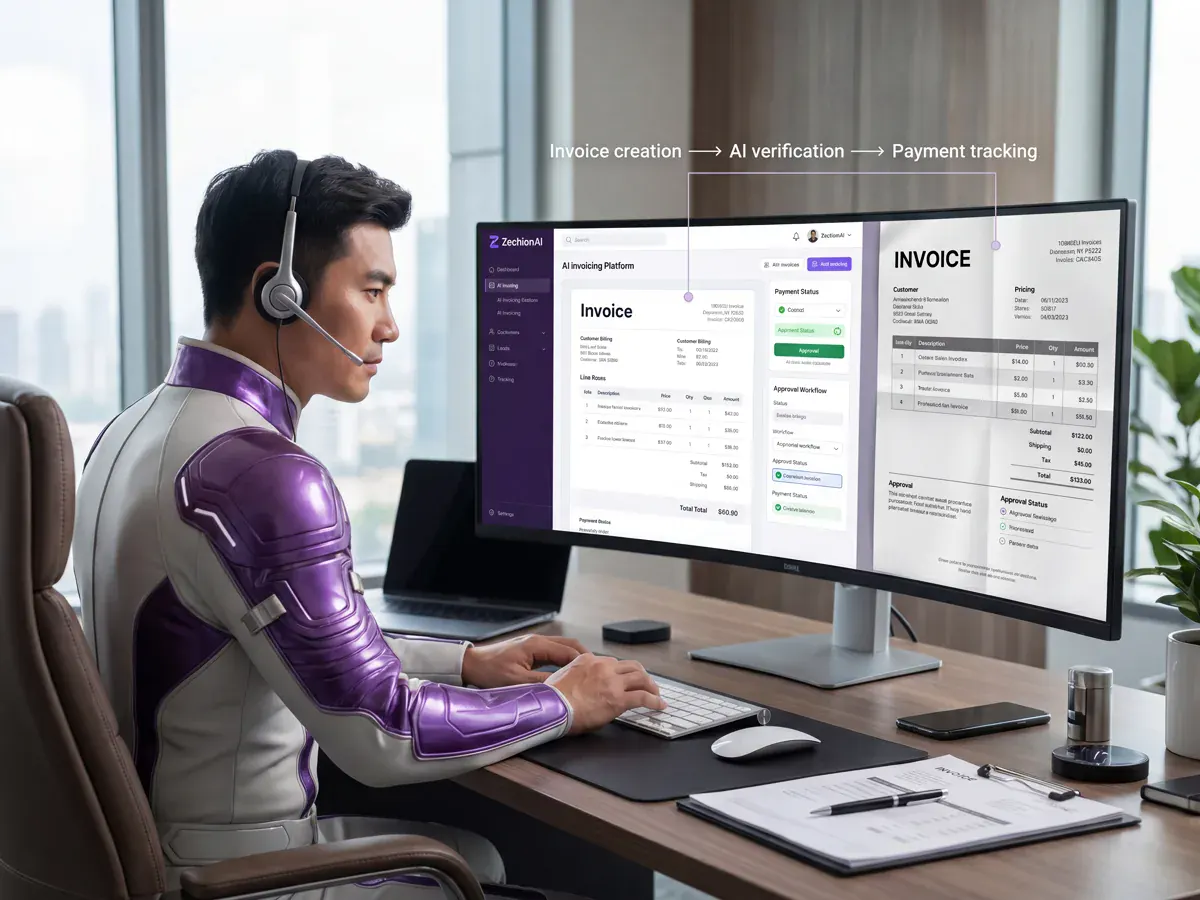 Document Processing & OCRTurn Documents Into Structured Data, Intelligent Workflows, and Actionable Information
- AI Agents & Autonomous AIAI Agents Built Around Real Business Workflows, Data, Tools, and Outcomes
 Computer VisionTurn Visual Data Into Actionable Intelligence
 MLOps & AI OperationsTurn Machine Learning Models Into Reliable, Production-Ready AI Systems
 AI Strategy & AdvisoryPractical AI Strategy for Scalable Business Transformation
 Intelligent AutomationAutomate Repetitive Work. Connect Your Systems. Improve How Your Business Operates.
 AI Security, Governance & ComplianceSecure AI. Govern AI. Deploy AI Responsibly.
ZechionAI can support route optimization, demand forecasting, shipment tracking, predictive analytics, intelligent automation, fleet analytics, warehouse intelligence, document processing, customer communication, and other AI use cases tied to logistics operations.
Yes. Route optimization solutions can consider factors such as vehicle capacity, delivery windows, traffic, driver availability, distance, priorities, and multiple delivery stops.
AI can identify patterns associated with delays and estimate the likelihood or expected timing of certain shipment events. Predictions depend on data quality and the operational factors available to the system.
Forecasting models analyze relevant historical and current data to estimate future demand. Depending on the use case, this may include order history, seasonality, geography, product behavior, promotions, lead times, and other factors.
Yes. Integration can be designed around available APIs, databases, data pipelines, or other technical interfaces. The exact approach depends on your existing systems and architecture.
Yes. GPS and telematics data can provide useful inputs for route optimization, fleet analytics, ETA prediction, driver analysis, and operational monitoring.
Yes. Shipment-monitoring workflows can collect status information, identify events or exceptions, update dashboards, and trigger defined notifications or escalation processes.
AI can support more informed ETA estimates by analyzing relevant operational and historical data. Actual improvement depends on the quality, coverage, and timeliness of the available data.
Yes. Purpose-built agents can support shipment tracking, dispatch operations, customer service, exception management, carrier coordination, and supply chain analysis.
Yes. A conversational interface can be connected to approved shipment information so customers or internal teams can ask questions about status, estimated delivery, milestones, and defined shipment events.
Yes. Existing operational data can be assessed for suitability, quality, completeness, accessibility, and relevance before selecting the appropriate AI approach.
Data quality issues are common in operational environments. ZechionAI can assess data gaps and develop appropriate data preparation, validation, integration, or improvement strategies before relying on the information for production AI.
There is no single timeline. A focused use case may require substantially less work than a multi-system transformation. Scope, integrations, data readiness, security requirements, testing, and deployment complexity all affect implementation time.
Yes. Starting with a clearly defined operational problem can be a practical way to establish value, validate data and integration requirements, and build an internal foundation for future AI initiatives.
Yes. Support can include model monitoring, data-quality monitoring, system maintenance, retraining, optimization, security monitoring, and ongoing technical support.
Performance should be measured against agreed baselines and business KPIs. Depending on the project, this may include route efficiency, cost per mile, ETA accuracy, forecast accuracy, fleet utilization, shipment visibility, or manual processing time.
Security requirements are addressed as part of solution architecture and can include access controls, encryption, secure APIs, role-based access, logging, data governance, and other appropriate controls.
Yes. Solutions can be architected with scalability in mind so successful capabilities can potentially be extended across locations, fleets, warehouses, routes, carriers, or business units.
Yes. ZechionAI can design and develop custom AI capabilities around your operational model, data, existing systems, workflows, and business objectives.
Start with an AI assessment or discovery discussion. ZechionAI can review your operational challenges, existing systems, available data, KPIs, and priorities to identify practical opportunities for AI.
Build a Smarter, More Predictable Supply Chain
The best logistics AI initiatives usually begin with a specific operational problem—not a technology wish list.
Talk to Zech, live